Why JD Edwards? The case for Oracle’s most underrated ERP platform
SAP and Dynamics dominate the conversation. JD Edwards EnterpriseOne quietly runs manufacturing, construction, distribution, and asset-intensive operations at a lower total cost — and Oracle is still investing in it.
By OneVision Consulting
Share on LinkedIn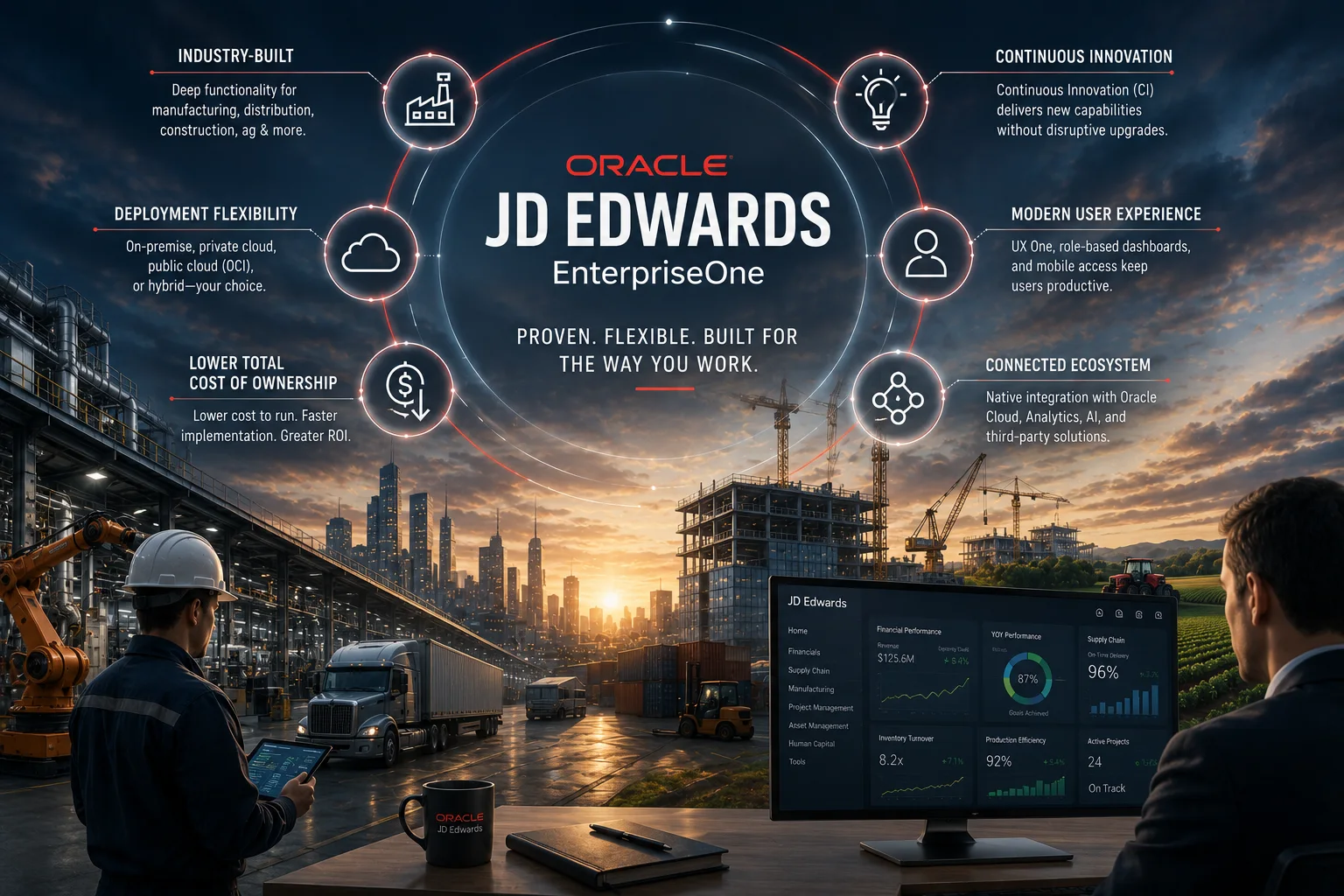
On this page
01The ERP platform you may have overlooked
In the crowded enterprise resource planning market, a few names dominate the conversation. SAP commands attention with its global enterprise footprint. Microsoft Dynamics attracts businesses that want a cloud-first answer. One platform consistently delivers exceptional value while attracting far less of the noise: Oracle JD Edwards EnterpriseOne.
For more than four decades, JD Edwards has run operations at thousands of mid-sized to large enterprises across manufacturing, construction, distribution, agribusiness, and asset-intensive industries. Despite that record it is still described as Oracle’s most underrated ERP platform — a designation that says more about market perception than about capability.
What it actually offers is a combination few competitors match: genuine deployment flexibility, industry-specific depth, lower total cost of ownership, and continuous innovation that does not require a full-scale upgrade to reach. What follows is the case for the platform in detail, along with an honest account of the organizations it does not suit.
02What JD Edwards is, and where it came from
JD Edwards EnterpriseOne is a fully integrated, industry-purpose-built ERP platform backed by Oracle, one of the largest enterprise software companies in the world. The current release represents more than forty years of continuous development.
Origins and evolution
JD Edwards began as an independent software company in the 1970s, building a reputation for robust, flexible ERP tailored to specific industries. Its early focus on manufacturing, distribution, and asset-intensive sectors established the functional depth that still distinguishes the product.
Oracle acquired JD Edwards in 2005. Contrary to widespread predictions that the platform would be quietly retired, Oracle has sustained and accelerated its development. The current release, EnterpriseOne 9.2, is the most capable version to date, and Oracle delivers regular Continuous Innovation updates that add capability without requiring a disruptive full-scale upgrade.
JD Edwards EnterpriseOne continues to receive continuous innovation updates, enabling organizations to adopt new capabilities without disruptive full-scale upgrades.
The platform today
- Breadth
- More than 80 application modules spanning financials, supply chain, manufacturing, asset management, human capital management, and project management.
- Deployment
- On-premise, private cloud, public cloud on Oracle Cloud Infrastructure, and hybrid configurations, all supported concurrently rather than as migration stages.
- Database
- Oracle Database, Microsoft SQL Server, IBM Db2, and PostgreSQL — no forced dependency on a single vendor’s database platform.
- Customer sentiment
- 4.0 out of 5.0 on Gartner Peer Insights across 108 validated reviews, with 76 percent of reviewers rating it four or five stars.
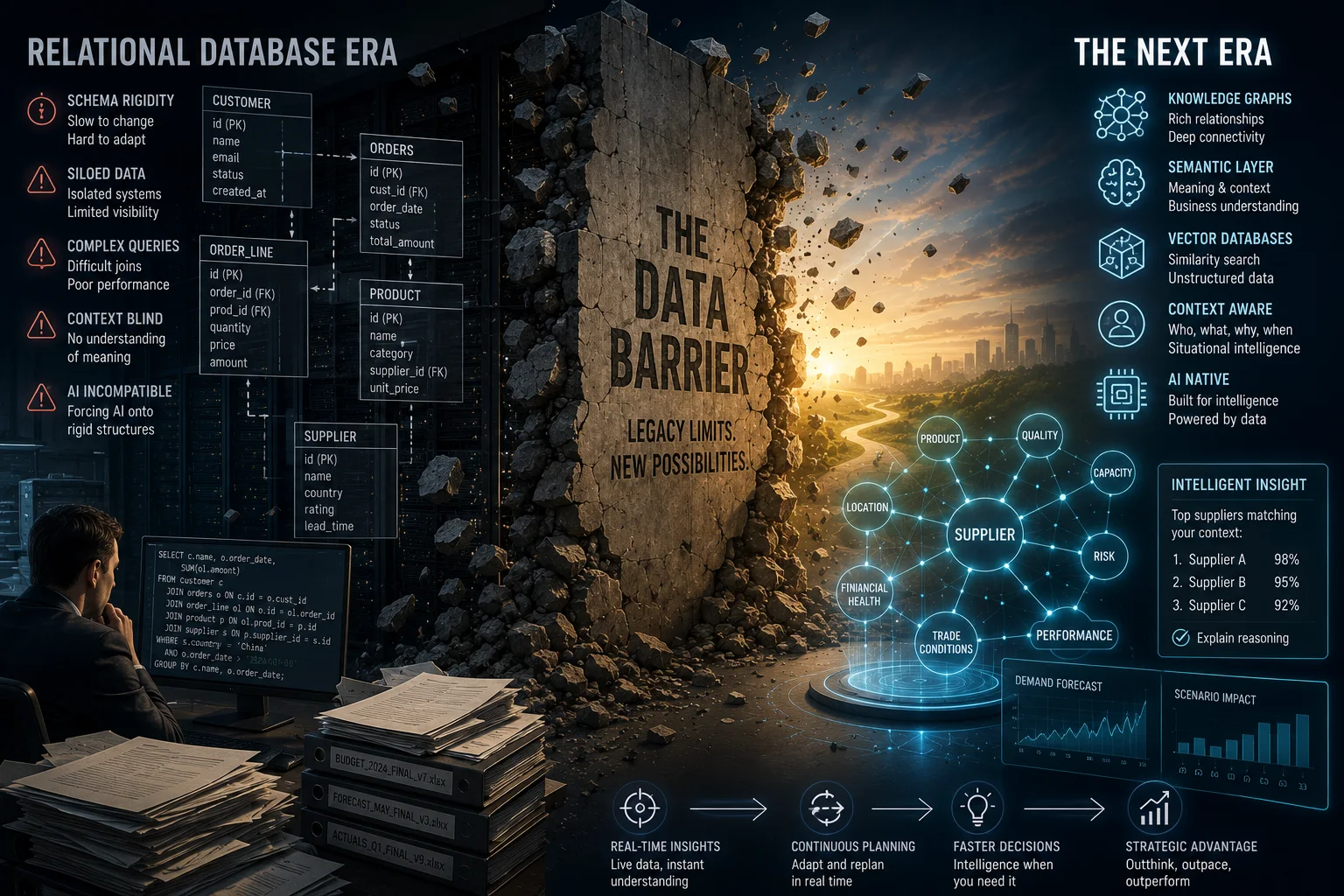
The architectural point underneath those figures matters more than any of them. Broad-market ERP suites ask companies to adapt their processes to the software. JD Edwards was designed around operational and asset-intensive industries, which is why it arrives with workflows those industries recognize rather than a configuration exercise that has to produce them.
03Why the platform is still relevant
In a market saturated with cloud-first mandates, it is fair to ask whether a platform with four decades of history can still be the right answer. Three things make the case.
Proven stability, with continuous innovation
JD Edwards pairs the maturity that comes from decades of real-world deployment with a delivery model that keeps adding capability. Newer platforms are still working through growing pains and functional gaps; EnterpriseOne’s functionality has been tested at scale for years. Oracle’s continued investment is visible in what has shipped recently.
- Enterprise Automation (2024), which turns transactional data into operational models and metrics.
- A sustainability framework (2024) for environmental data management embedded in operations rather than reported alongside them.
- UX One, providing role-based, personalized dashboards aligned to how people actually work.
- Orchestrator Studio, a no-code and low-code builder for automation and integration.
Industry depth that generalist suites do not carry
While SAP and Microsoft Dynamics aim to serve every industry, JD Edwards concentrated on the sectors where business processes are hardest to standardize. That focus produces pre-built, tested workflows for manufacturing, construction, distribution, agribusiness, real estate, and asset-intensive industries such as oil and gas, pulp and paper, and metals.
JDE’s deep functionality in asset-intensive industries — such as oil and gas, pulp and paper, and metals — makes it a preferred choice over SAP for companies operating within those verticals.
The practical consequence is that customers in those industries get the functionality they need close to out of the box, instead of spending months or years configuring generic modules toward it.
Hybrid cloud as a position, not a transition
Where competitors push cloud-only mandates, JD Edwards treats deployment as the customer’s decision. Organizations run it on-premise, in private cloud, on Oracle Cloud Infrastructure, or in hybrid configurations, and Oracle supports all four as destinations rather than as waypoints on the way to one of them.
That flexibility matters for any organization with existing infrastructure investment, regulatory constraints, or operational realities that make a cloud-only architecture impractical. It meets businesses where they are instead of where a vendor roadmap would prefer them to be.
04Eight strengths that set it apart
1. Deployment flexibility
JD Edwards is the only major ERP platform offering genuine choice across all four deployment models without forcing migration to a single architecture. That lets organizations preserve existing infrastructure investment, meet industry-specific compliance requirements, move to cloud on their own schedule, and retain control over sensitive data and processes.
The contrast is the point. SAP S/4HANA is moving toward a cloud-first and eventually cloud-only model, which removes on-premise flexibility and creates a migration program that has to be funded. Microsoft Dynamics 365 is primarily software as a service, with limited on-premise or hybrid support.
2. Lower total cost of ownership
Cost advantages accumulate from five specific properties rather than from discounting.
- Modular licensing
- Pay for the modules in use rather than an enterprise-wide entitlement.
- Faster implementation
- A phased, modular rollout reduces both upfront cost and the amount at risk in any one phase.
- Simpler upgrades
- Continuous Innovation updates need fewer consultants and cause less disruption than a release-to-release migration.
- Database choice
- Four supported databases means no forced platform migration to satisfy a vendor dependency.
- Leaner staffing
- A simpler architecture can be run effectively by a smaller team, which is the cost that compounds year after year.
Against S/4HANA specifically, the differences show up as lower implementation complexity, modular rather than enterprise-wide licensing, minimal rather than high upgrade disruption, and leaner rather than larger specialized teams. Research on ERP programs consistently identifies high cost, budget overruns, and schedule extension as the dominant barriers, and a modular approach addresses all three directly.
3. Industry-specific functionality
Rather than a configure-everything model, JD Edwards ships tested workflows for the industries it targets.
- Manufacturing
- Discrete, process, repetitive, and mixed-mode manufacturing in one environment, blend management for food, beverage, and winemaking, quality management integrated with production, and a configurator for engineer-to-order products.
- Construction and engineering
- Native subcontractor and procurement management, project costing from inception to close, change management, contract billing, and a homebuilder management module with no comparable equivalent in SAP without customization.
- Distribution and logistics
- End-to-end order lifecycle visibility, an advanced pricing engine, natively integrated warehouse and transportation management, and apparel management with attribute, style, and SKU handling.
- Agribusiness
- Crop and field lifecycle management from block to bottle and crop to product, grower management and payments, and blend management for wineries and food processors.
- Real estate and assets
- Real estate management with advanced forecasting, condition-based maintenance, and capital asset planning with full lifecycle costing.
This is where most of the cost and timeline advantage originates. Implementation effort is largely the distance between what the software does on day one and what the business needs it to do, and that distance is shorter when the software was built for the industry.
4. Asset lifecycle management
The asset lifecycle management module is among the most complete in the market, covering capital planning and budgeting, equipment procurement and operations, predictive and condition-based maintenance, real estate and rental management, and equipment cost analysis.
Two comparisons are worth making. Against SAP Plant Maintenance, JD Edwards delivers comparable capability with lower configuration overhead. Against IBM Maximo — a strong standalone product — the difference is integration: Maximo requires middleware to connect to financials, supply chain, and HR, while asset lifecycle management is already inside the same system as all three. For utilities, oil and gas, facilities management, and asset-heavy manufacturing, that difference is the whole argument.
5. Modular architecture
The modular design lets organizations deploy only what current operations need, add capability without a full system overhaul, and upgrade in pieces while preserving existing configuration.
JDE supports modular implementation, letting companies deploy modules in a phased manner, scaled up with low-to-no operational disruption.
This addresses the single most expensive failure mode in ERP. Research consistently finds that fewer than one in ten ERP projects is considered fully successful, often because scope was underestimated and everything was changed at once. SAP programs typically arrive as large-scale business transformation initiatives running 12 to 36 months before go-live, which concentrates risk and delays any return.
6. Customization that survives upgrades
Most ERP platforms force a choice between fitting the business and staying upgradable. Heavy customization means painful, expensive upgrades. JD Edwards resolves the tension architecturally, with four mechanisms that sit alongside core code rather than inside it.
- Business function calls, which hold custom logic non-destructively.
- Processing options, which change behavior through flags rather than code.
- Orchestrator Studio, which builds custom workflows without modification.
- UX One, which personalizes the interface without touching the core system.
The consequence is that customizations survive upgrades, where custom ABAP in an SAP environment frequently requires rework with each release. For organizations whose processes are a genuine source of advantage rather than an accident of history, this is often the deciding factor.
7. Orchestrator, included
Orchestrator is a native integration and automation engine built into EnterpriseOne. It handles API connections to third-party systems such as CRM, IoT platforms, warehouse management, and business intelligence tools, event-driven and rules-based automation, real-time notification and approval, and direct ingestion of sensor data into operational workflows.
The commercial difference is straightforward: equivalent capability in an SAP environment means licensing a separate middleware platform in SAP Business Technology Platform, while Orchestrator is part of the core product at no additional cost. As the number of specialized applications any business runs keeps growing, an included integration engine stops being a technical detail and becomes a line in the budget that is not there.
8. Continuous Innovation updates
Oracle delivers Continuous Innovation updates as incremental releases that require no full-system upgrade, can be adopted selectively module by module, and preserve existing configuration and customization.
Set that against the traditional alternative. Upgrade projects are repeatedly identified in ERP research as major undertakings in their own right, demanding technical planning, database migration, and dedicated risk management — which is precisely what an S/4HANA upgrade cycle involves, given the HANA dependency. The Continuous Innovation model means staying current is maintenance rather than a program.
05The Oracle ecosystem advantage
One of the platform’s least discussed strengths is what surrounds it. JD Edwards customers can draw on Oracle’s wider technology stack without leaving the ERP they already run.
- Cloud Infrastructure
- Enterprise-grade performance, security, and cost efficiency on OCI, without the burden of operating the infrastructure.
- Analytics Cloud
- Embedded analytics and reporting over EnterpriseOne data, complemented by the Enterprise Automation capability introduced in 2024.
- Autonomous Database
- Self-tuning, self-securing, and self-patching database technology, which removes a meaningful share of administrative overhead.
- AI and ML services
- Predictive maintenance, demand forecasting, and natural language processing applied to EnterpriseOne data without migrating to a different platform.
- Mobile platform
- More than 80 pre-built mobile applications extending the system to field crews, warehouse staff, and executives.
- Digital Assistant
- Conversational access to transactions, so common tasks do not require navigating the menu structure to complete.
The comparison worth drawing is on sourcing. These are enterprise-grade AI, database, analytics, and cloud capabilities available from the same vendor as the ERP, where the equivalent in an SAP environment is frequently assembled from partners or licensed through SAP Business Technology Platform at additional cost.
06How it compares
Against SAP S/4HANA
This comparison is a choice between two philosophies rather than two feature lists. JD Edwards argues that software should adapt to the operation. SAP argues that the operation should standardize on the software. Both positions are defensible, and which one is right depends entirely on the organization.
JD Edwards leads on total cost of ownership, implementation speed and disruption, deployment flexibility, depth in asset-intensive industries, upgrade-safe customization, and phased adoption. S/4HANA leads on global presence and market share, breadth of partner ecosystem, functional coverage across every industry, and suitability for very large, complex, multinational enterprises.
For mid-sized to large enterprises in manufacturing, construction, distribution, agribusiness, or asset-intensive operations, JD Edwards typically delivers better value, faster, at lower long-term cost. For a global enterprise that genuinely needs standardized processes across dozens of countries and business units, SAP may well justify the additional investment. Anyone claiming one of these platforms wins every comparison is selling something.
Against Microsoft Dynamics 365
Dynamics 365 is a different kind of competitor: cloud-first, with strong gravitational pull toward the rest of the Microsoft estate. JD Edwards is deeper on industry-specific functionality, asset lifecycle management, manufacturing capability, and hybrid deployment, and lower in total cost for complex operations.
Dynamics is stronger on integration with Microsoft 365 and the Power Platform, ships a more modern interface out of the box, can be implemented faster for simpler requirements, and is well established in retail and professional services. For complex manufacturing, asset management, or industry-specific requirements, JD Edwards offers materially more depth. For an organization whose priority is the Microsoft ecosystem and whose operational needs are straightforward, Dynamics may be entirely sufficient.
07Who it suits, and who it does not
JD Edwards EnterpriseOne is the right answer for organizations that recognize themselves in most of the following.
- Operating in manufacturing, construction, engineering, distribution, agribusiness, real estate, oil and gas, or another asset-intensive industry.
- Needing deployment flexibility, because a cloud-only mandate is either impossible or undesirable.
- Wanting to preserve business processes that work, rather than conform them to software-defined workflows.
- Treating asset lifecycle management as a core business function rather than a maintenance ledger.
- Valuing lower total cost of ownership and a phased, modular adoption path over a single transformation program.
- Requiring deep customization that continues to work after an upgrade.
- Already running JD Edwards, and wanting to extract more value from it before entertaining a platform change.
Where it is already doing this
- Consumer packaged goods
- KIND Snacks selected JD Edwards for the flexibility to keep pace with rapid growth and changing operational needs.
- Construction
- Contractors choose it for native subcontractor management, project costing, and change management that competitors cannot match without extensive customization.
- Agribusiness
- Producers run it for crop-to-product lifecycle management, blend management, and grower payments designed for the industry rather than adapted to it.
- Asset-intensive manufacturing
- Manufacturers rely on full asset lifecycle integration, condition-based maintenance, and upgrade costs low enough to protect a long-term investment.
When to look elsewhere
An honest case includes the cases it does not cover. JD Edwards is probably the wrong platform for an organization that operates primarily outside its core industries — pure financial services, insurance, or healthcare — that needs extensive localization for countries where the platform has limited presence, that values the largest available partner ecosystem above functional fit, or that ranks consumer-grade user experience as its first requirement, notwithstanding the improvement UX One has delivered.
Any of those makes a different platform the better answer, and no amount of implementation skill compensates for a fit that is not there.
08The AI and innovation roadmap
The reasonable question about any mature ERP platform is whether it can keep pace with artificial intelligence and machine learning. Oracle’s investment answers it in three parts.
What exists today
- Enterprise Automation (2024), turning transactional data into actionable insight and operational metrics.
- Oracle Digital Assistant, providing a conversational interface to transactions with no third-party chatbot required.
- Predictive analytics through Oracle AI services, applied to EnterpriseOne data for anomaly detection, forecasting, and pattern recognition.
What the ecosystem adds
Because Oracle AI and machine learning services run on the same cloud infrastructure, customers reach them without migrating platforms. The applications that matter most in these industries are predictive maintenance from IoT sensor data, demand forecasting that improves inventory position, intelligent automation of routine work, and natural language processing for conversational access and document handling.
Orchestrator is what makes the first of those practical. Sensor data feeds directly into workflows, which is how predictive maintenance and demand-driven replenishment happen without a custom integration project standing between the reading and the action. The sustainability framework does the equivalent for environmental data, embedding it in operations rather than assembling it for a report at quarter end.
A caveat is worth stating plainly. AI capability in any ERP is only as good as the data underneath it, and an EnterpriseOne environment carrying years of undocumented customization and inconsistent master data will not produce reliable forecasts because a model has been pointed at it. The data work comes first.
09The four objections worth answering
- Is it outdated?
- This is the most common misconception, and it confuses age with obsolescence. EnterpriseOne 9.2 with Continuous Innovation updates is a contemporary architecture with contemporary capability. The platform’s maturity is an asset — battle-tested functionality and proven scalability — provided the environment is kept current. An installation several tools releases behind is a maintenance problem, not evidence about the product.
- What about Oracle’s cloud strategy?
- Oracle fully supports JD Edwards on Oracle Cloud Infrastructure while continuing to support on-premise and hybrid deployment. Hybrid by design means choice rather than a one-size-fits-all cloud mandate, and Oracle has committed to EnterpriseOne well into the next decade.
- Can it handle our growth?
- It scales from mid-sized companies to enterprises with billions in revenue. The modular architecture is what makes that possible: capability is added as the business needs it, without replacing the core platform to accommodate the next stage.
- What about implementation risk?
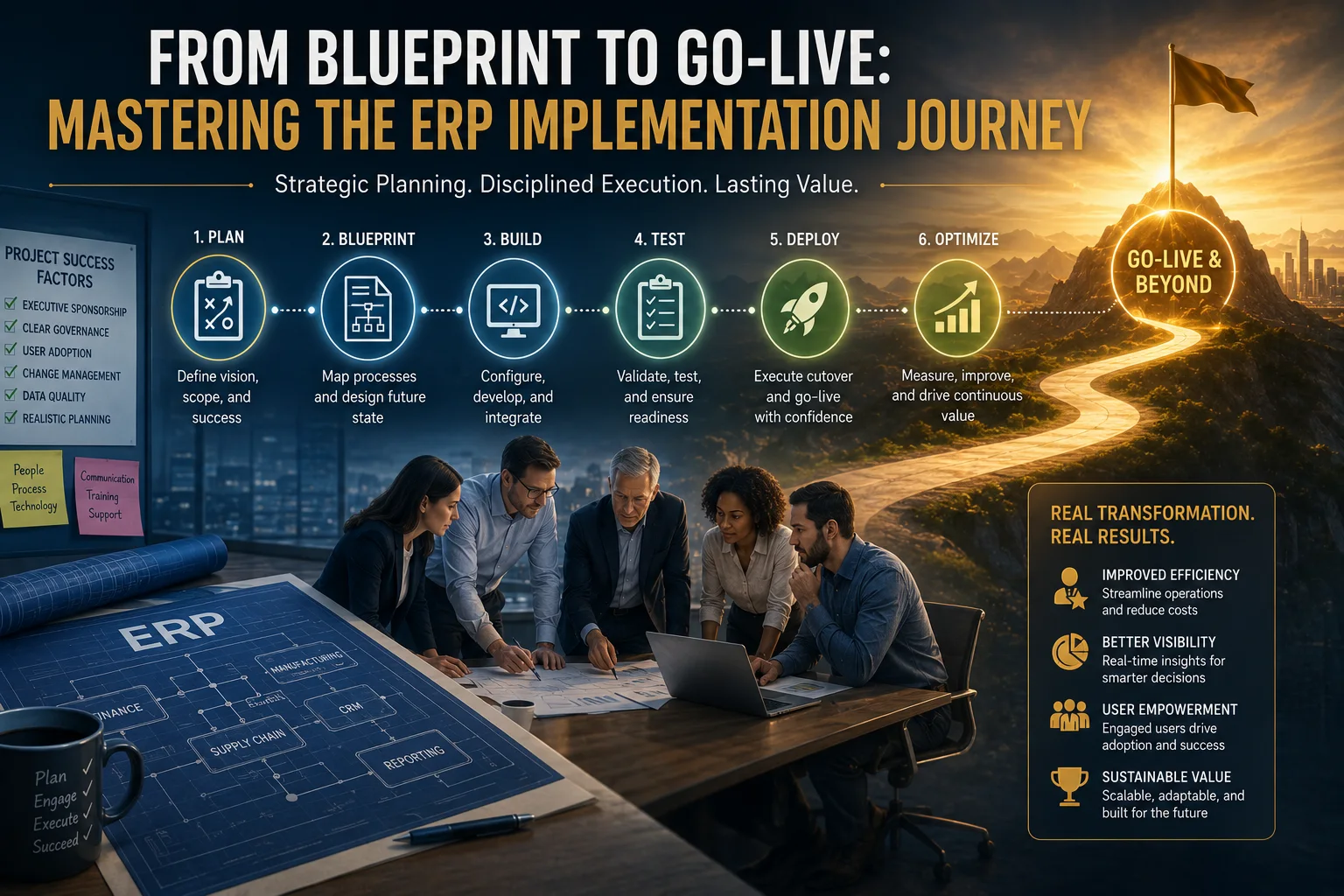
- Every ERP implementation carries risk, and the research is consistent about where it comes from — organizational change, executive sponsorship, user training, and system integration rather than software defects. Phased delivery, pre-built industry workflows, and customizations that survive upgrades all reduce that exposure, but none of them removes it. The risk is managed, not eliminated.
10Making the decision
Choosing an ERP platform is among the most consequential technology decisions an organization makes. The wrong choice produces years of operational disruption and wasted investment. The right one becomes the foundation everything else is built on. Seven questions settle it faster than any feature comparison.
- 01Industry fit: does your industry align with the platform’s core strengths in manufacturing, construction, distribution, agribusiness, and asset-intensive operations?
- 02Deployment: do you need flexibility in where the system runs, or is a cloud-only model acceptable?
- 03Customization: how far will the software need to bend to fit your processes, and can you afford for that work to break at every upgrade?
- 04Total cost of ownership: what is the realistic figure across implementation, maintenance, upgrades, and staffing over ten years or more, rather than the license quote?
- 05Timeline: how quickly do you need value, and can the business absorb a multi-year program before anything goes live?
- 06Asset management: is asset lifecycle management a core business function that needs deep, integrated capability?
- 07Existing platform: if you already run JD Edwards, have you exhausted the optimization case before opening the replacement case?
Where the answers align with the platform’s strengths, JD Edwards deserves serious consideration on the strength of proven stability, continuous innovation, industry depth that reduces customization, deployment flexibility, lower total cost of ownership, and a credible path into AI, IoT, and sustainability reporting.
When organizations compare JD Edwards and SAP, the decision should not be driven by feature count alone. The ERP that delivers the greatest long-term value is the one that aligns with your operational model, implementation capacity, and future growth strategy.
11Underrated, not outdated
JD Edwards EnterpriseOne may be Oracle’s most underrated ERP platform, but the designation describes market perception rather than the product. For organizations in the right industries with the right requirements, it delivers value competitors struggle to match — deployment flexibility, industry depth, lower total cost of ownership, integrated asset lifecycle management, included integration and automation, and continuous innovation, with the Oracle ecosystem behind all of it.
The question was never whether JD Edwards is a capable ERP platform. It plainly is. The question is whether it fits your industry, your operating model, and your direction — and for a great many mid-sized to large enterprises in manufacturing, construction, distribution, agribusiness, and asset-intensive operations, it does.
The organizations that get the least from it are not the ones that chose wrongly. They are the ones that chose well, then ran the platform several tools releases behind with a customization layer nobody documented. That is a stewardship problem, and it is fixable.
12Sources
This article draws on publicly available vendor and analyst material, peer-reviewed research on ERP implementation and upgrade projects, and OneVision Consulting’s own delivery experience, current as of July 2026. All product names are trademarks of their respective owners.
- Oracle
- JD Edwards EnterpriseOne product documentation and the Oracle JD Edwards blog, for release capability, Continuous Innovation updates, Enterprise Automation, the sustainability framework, UX One, Orchestrator, and the mobile and digital assistant platforms.
- Gartner
- Gartner Peer Insights reviews of Oracle JD Edwards EnterpriseOne, for the 4.0 out of 5.0 rating across 108 validated reviews.
- Integrative Systems
- “JD Edwards vs SAP — Which ERP Is Right for Your Business?”, for the total cost of ownership, upgrade, and modular implementation comparisons.
- ERP Suites
- “JDE versus SAP: An Epic ERP Showdown”, for asset-intensive industry depth and the KIND Snacks example.
- Academic research
- Peer-reviewed studies on ERP critical success factors, implementation and post-implementation outcomes, upgrade projects, and AI integration in enterprise systems, published between 2019 and 2025.